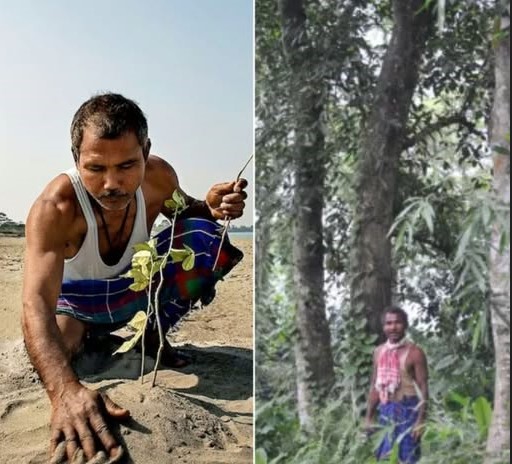
Jadav Payeng, often called the “Forest Man of India,” spent roughly four decades planting trees on a barren sandbar along the Brahmaputra River in Assam
Cultural Creatives
Jadav Payeng, often called the “Forest Man of India,” spent roughly four decades planting trees on a barren sandbar along the Brahmaputra River in Assam. What began as a personal effort to restore damaged land slowly grew into a vast green expanse of about 1,360 acres, now known as Molai Forest. Starting in the late 1970s, he planted and protected seedlings year after year, working largely alone in the early stages when the area had little vegetation and harsh conditions.
Over time, the once-empty sandbar transformed into a living forest with layered plant growth, shade cover, and stable soil. As the trees matured, wildlife began to return — including birds, deer, and other native species — forming a functioning ecosystem where there had previously been almost none. The forest also helped reduce erosion and improved local environmental balance by holding moisture and supporting biodiversity.
His long-term dedication shows how consistent small actions can reshape a landscape. Instead of a short campaign, this was steady, hands-on restoration across decades. Today, the forest stands as proof that one person’s persistence can revive damaged land and create space for nature to recover and thrive.