A video shared by The Better India highlights the work of Gurunandan Rao, a mechanical engineer and Founder of HandsOn Foundation, who played a key role in restoring “Lalbagh Lake” using science-led, nature-first methods. Spread across nearly 30 acres within Lalbagh Botanical Garden, the lake had fallen into severe ecological distress, marked by foul odour, pale-yellow water, eutrophication, algal blooms, and dangerously low dissolved oxygen levels.
According to reporting in “Bangalore Mirror” (29 January 2026), the restoration project began in December 2024 as a long-term ecological recovery mission rather than a cosmetic beautification exercise . Baseline testing showed critically low dissolved oxygen levels of just 1.4 mg/L, indicating severe biological stress. The lake was suffering from nutrient overload, organic accumulation, and poor circulation common issues affecting many of Bengaluru’s urban water bodies.
Rao and his team adopted a science-driven approach combining biological treatment systems with mechanical support. Submersible and surface aerators were installed to improve water circulation and prevent anaerobic conditions. Floating gardens essentially constructed wetlands installed on UV-stable platforms were introduced to function as living bio-filters. Planted with native wetland species, these floating systems absorb excess nitrogen and phosphorus, support microbial biofilms that break down organic matter, and reduce algal growth by limiting nutrient availability. The floating gardens also provide partial surface shading, helping regulate water temperature and improve dissolved oxygen in plant root zones.
The restoration was completed by September 2025, followed by continued monitoring to ensure plant survival, microbial colonisation, and overall system stability. The project faced operational challenges, including nutrient-rich runoff from surrounding urban areas and depth variations across the lake. Careful placement of aeration systems and floating wetlands was required to ensure uniform oxygen distribution across the 30-acre water body.
Rao’s work reflects a broader shift in urban lake restoration from heavy civil engineering toward ecological regeneration. Instead of relying solely on dredging or large infrastructure, the Lalbagh initiative emphasised low-maintenance, sustainable interventions that work with natural processes. The project demonstrates how scientific planning, technical expertise, and citizen-driven initiatives can contribute to restoring degraded urban ecosystems.
Beyond ecological revival, the restored lake strengthens groundwater recharge, improves local microclimates, and enhances biodiversity within one of Bengaluru’s most historic green spaces. Rao’s initiative illustrates how technical knowledge, when combined with community-oriented environmental stewardship, can offer scalable solutions for urban climate resilience in rapidly growing cities.
(The Better India video, February 2026; Bangalore Mirror, 29 January 2026)
← Back to Stories
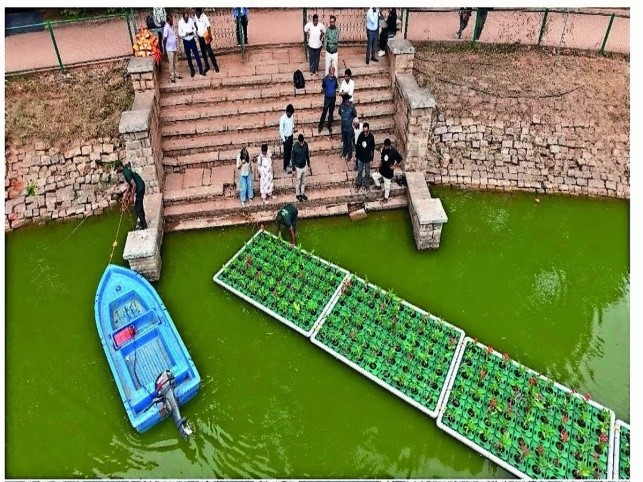
India: Engineer Gurunandan Rao’s science-led effort to revive Bengaluru’s Lalbagh Lake