The Flood that changed a suburb in Chennai

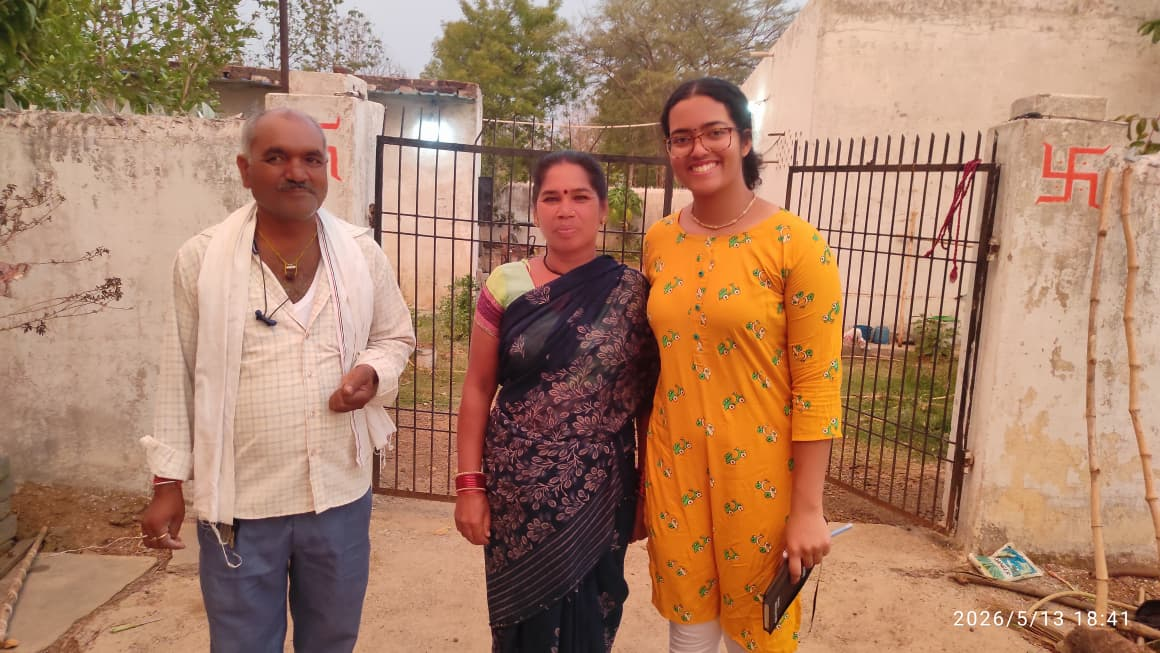
As part of the NIAS Climate Change, Civil Society and Peace (C3SP) initiative in collaboration with GPPAC South Asia, Preetha Renganarayanan, Research Assistant at the National Institute of Advanced Studies (NIAS), Bengaluru, undertook a field visit to Medavakkam (a southern suburb of Chennai) and interacted with local resident and environmental volunteer Arjun Shankar to understand the ecological and governance dimensions of urban flooding in Chennai. As one of the areas severely affected during Cyclone Michaung in December 2023, Medavakkam has since come about as an important example of citizen-led environmental action, where residents have mobilised around lake restoration, flood mitigation, and ecological conservation.
This case study examines how repeated flooding transformed local residents into active climate responders, the role of citizen mobilisation in strengthening environmental governance, and the challenges of translating grassroots initiatives into sustained institutional action. It also reflects on the lessons Medavakkam provides for integrating community participation, ecological restoration, and long-term urban flood resilience as climate-related disasters become more frequent and intense.
On 04 December 2023, as Cyclone Michaung struck Chennai with intense rainfall, several parts of the city descended into chaos. Among the most widely circulated visuals from the floods were scenes from Puravankara Windermere apartments in Pallikaranai, where floodwaters came through with such force that compound walls collapsed and parked cars floated through the inundated apartment complex. For residents living around the Vadakkupattu Lake, locally known as the Medavakkam Periya Eri, the flooding did not just stand as a natural disaster, it exposed years of ecological neglect, missing flood infrastructure, and the increasing vulnerability of Chennai’s rapidly urbanising peripheries.
The most severe impact of the Cyclone was felt in low-lying areas around Medavakkam Periya Eri, which includes the Puravankara apartment complex. As the lake reached full capacity, the flood surplus exerted pressure on the tank bund. In the absence of an adequate surplus weir (a structure designed to safely discharge excess water) portions of the bund failed, leading to uncontrolled overflow into the nearby residential areas. Water levels in surrounding neighbourhoods reportedly rose up to five feet in certain stretches. A citizen-led audit later estimated that nearly 20,000–25,000 people across Medavakkam, Vadakkupattu, Pallikaranai, and surrounding localities were affected, with property losses estimated at nearly INR 50 crore.
But the story of Medavakkam is not only about flooding. It is also about how ordinary residents having faced repeated climate disasters, governance and infrastructure failures, began transforming themselves into active ecological stakeholders and climate responders. Among them was Arjun Shankar.
When local residents became climate responders
Arjun Shankar is an IT professional and a resident of Medavakkam. Before the 2023 floods, his civic engagement largely revolved around disability-related issues and community welfare efforts. But Cyclone Michaung marked a turning point in his relationship with environmental and civic action. Standing atop the now partially restored Medavakkam Periya Eri, Arjun recalled how the floods transformed the locality into what he described as an “island-like situation.” As he walked around the lake bund, pointing toward the nearby Kalleri and Chinna Eri, he explained that the flooding in Medavakkam was not caused by a single water body alone. He pointed that it was the cumulative consequence of multiple lakes overflowing simultaneously in the lack of a well-structured outlet.
“All the apartments and infrastructure that were affected were located in the natural flow path of these lakes,” he noted.
For Arjun, the flooding became an entry point into climate and ecological action. What started as concern over local flooding eventually shifted to active involvement in lake restoration efforts, citizen mobilisation campaigns, and engagement with questions of flood mitigation, and groundwater preservation.
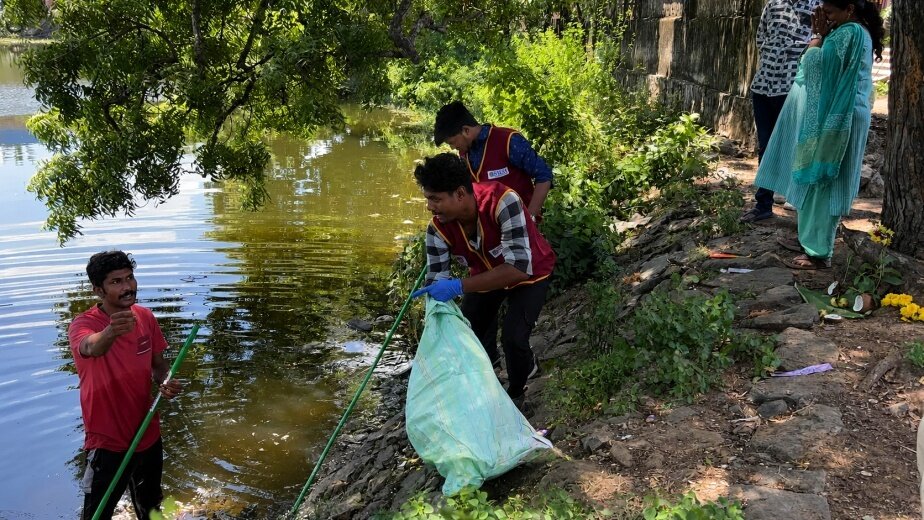
Photo Credits: Preetha Renganarayanan (Medavakkam Periya Eri)
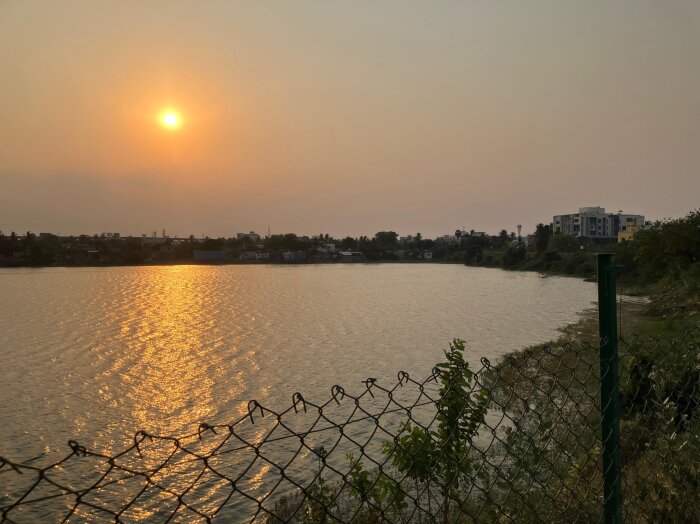
Three lakes, one floodplain
At the centre of Medavakkam’s flooding issue lies a key ecological aspect: the interconnected nature of Chennai’s urban lake systems. Medavakkam Periya Eri was historically one of the largest tanks in the Medavakkam region, originally spanning nearly 150 acres before shrinking to around 80 acres over time. Alongside Kalleri and Chinna Eri, the lake formed part of a broader hydrological network that historically helped absorb, store, and channel rainwater.
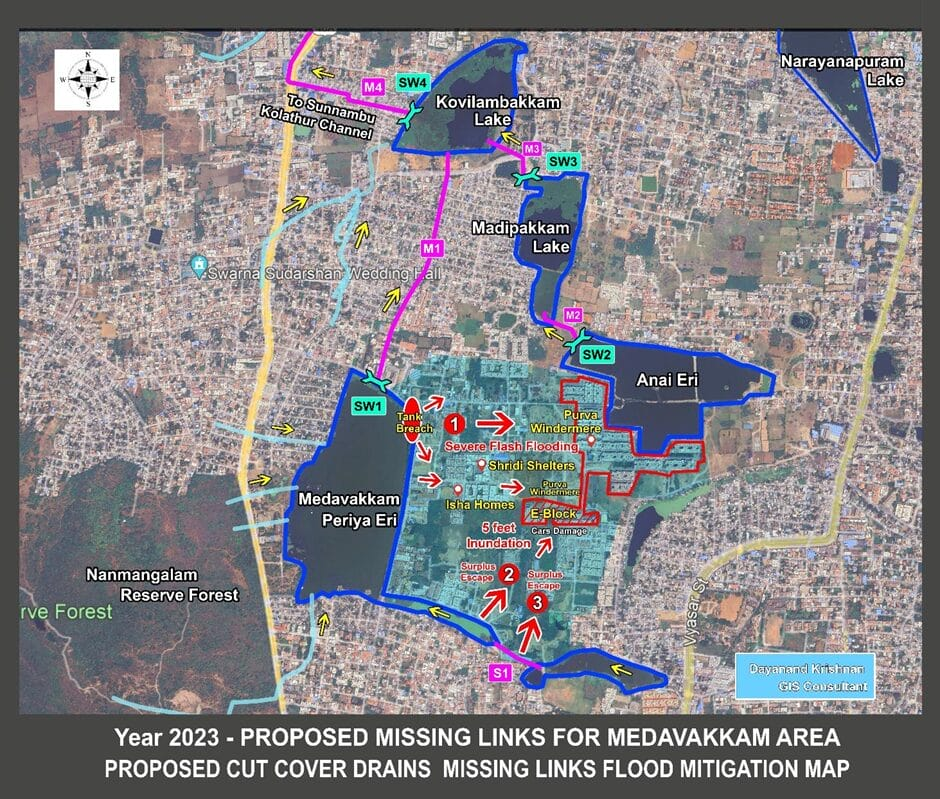
However, rapid urbanisation, shrinking water bodies, missing surplus channels, and inadequate maintenance have severely altered these systems. A citizen audit conducted by residents and technical experts following the 2023 floods highlighted multiple infrastructural failures. According to the audit, the absence of proper flood regulators, surplus weirs, and functioning surplus channels played a critical role in the uncontrolled discharge of floodwaters into residential areas. The audit also pointed to failures in engineering monitoring, maintenance, manpower, and long-term planning by the Water Resources Department (WRD).
Another important issue raised by Arjun was the phenomenon of reverse flow between lakes. While Medavakkam Periya Eri reportedly retains relatively better water quality, Kalleri remains heavily polluted with sewage inflow and invasive water hyacinths. According to Arjun, reverse flow from Kalleri into Periya Eri could gradually degrade the latter’s water quality as well.
In this context, Arjun reflects on how lake restoration extends beyond flooding. He notes that it becomes a long-term question over groundwater security, ecological sustainability, and the future environmental health of the locality. “We should not think only about flooding,” he said. “Groundwater is equally important. These lakes recharge groundwater. If they continue deteriorating, future water scarcity will become a much bigger problem.”
The Postcard Campaign: A call for attention on Kalleri and Chinna Eri
While some restoration work has begun around Medavakkam Periya Eri, residents argue that nearby Kalleri and Chinna Eri continue to remain neglected despite their importance within the region’s flood ecology. In response, Medavakkam residents led a postcard campaign in 2024 demanding ecological restoration of the lakes. Nearly 1,000 residents reportedly sent postcards addressed to the Tamil Nadu Chief Secretary, calling for immediate action to restore Kalleri and Chinna Eri, remove sewage inflows, and strengthen flood mitigation infrastructure.
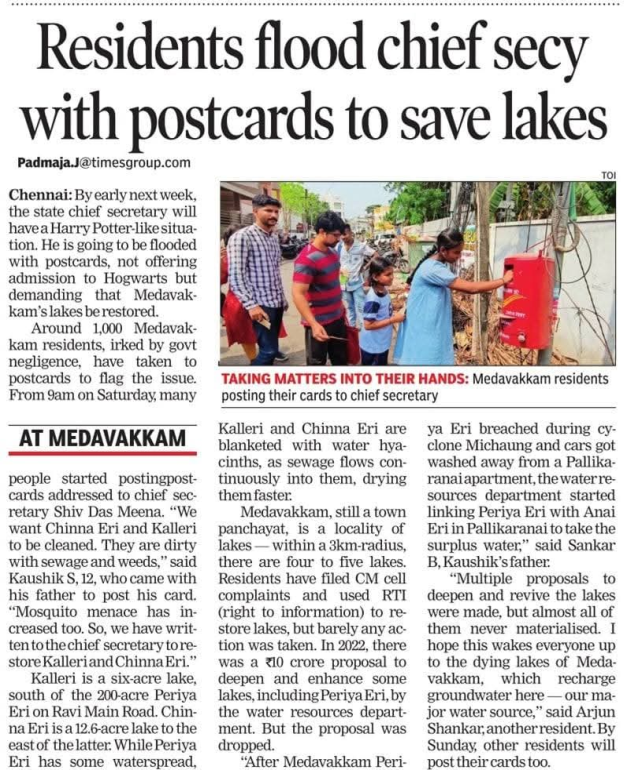
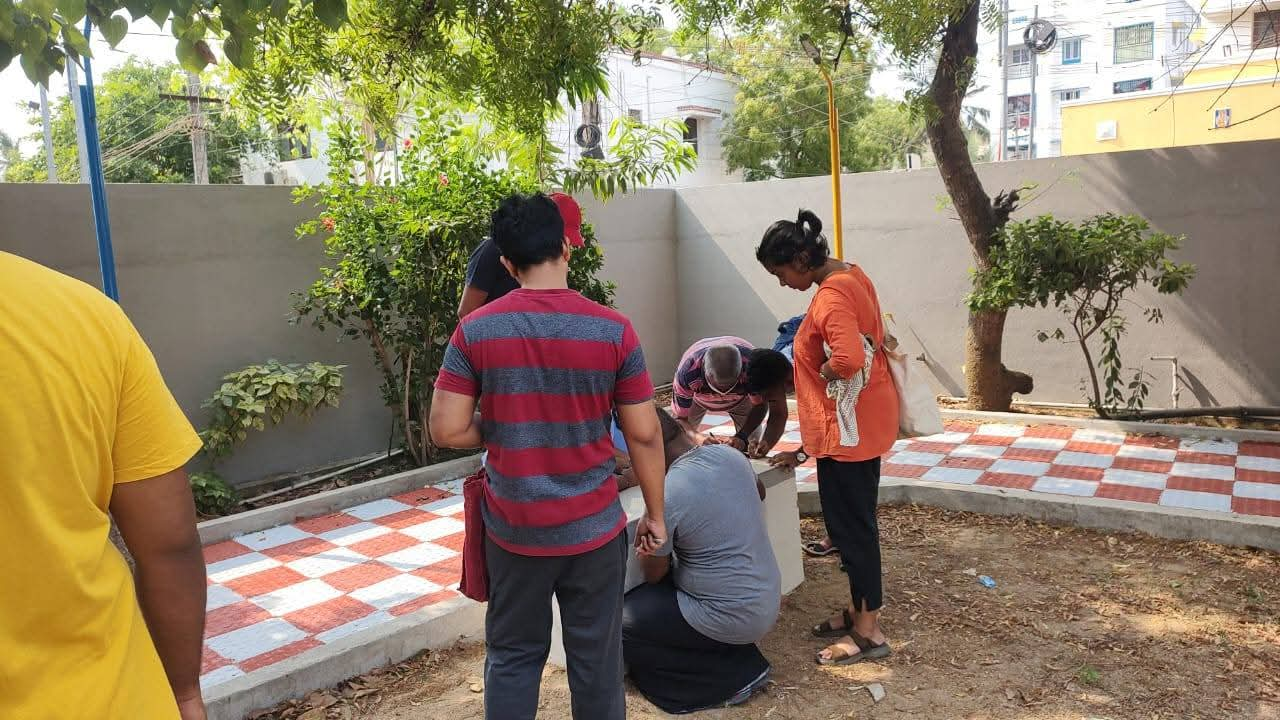
For residents, the campaign reflected both frustration and persistence. Previous complaints through RTIs and grievance portals such as CM Cell provided limited outcomes. However, the postcard campaign succeeded in drawing wider public attention, particularly through coverage by newspapers such as The Times of India.
The media, according to Arjun, played an important role in amplifying citizen concerns and pressuring authorities to respond. Subsequently, government officials indicated that proposals for eco-restoration including lake deepening and bund strengthening were under consideration. However, residents later filed RTIs seeking updates regarding budgets, timelines, and implementation status, only to discover that restoration work had not materially begun.
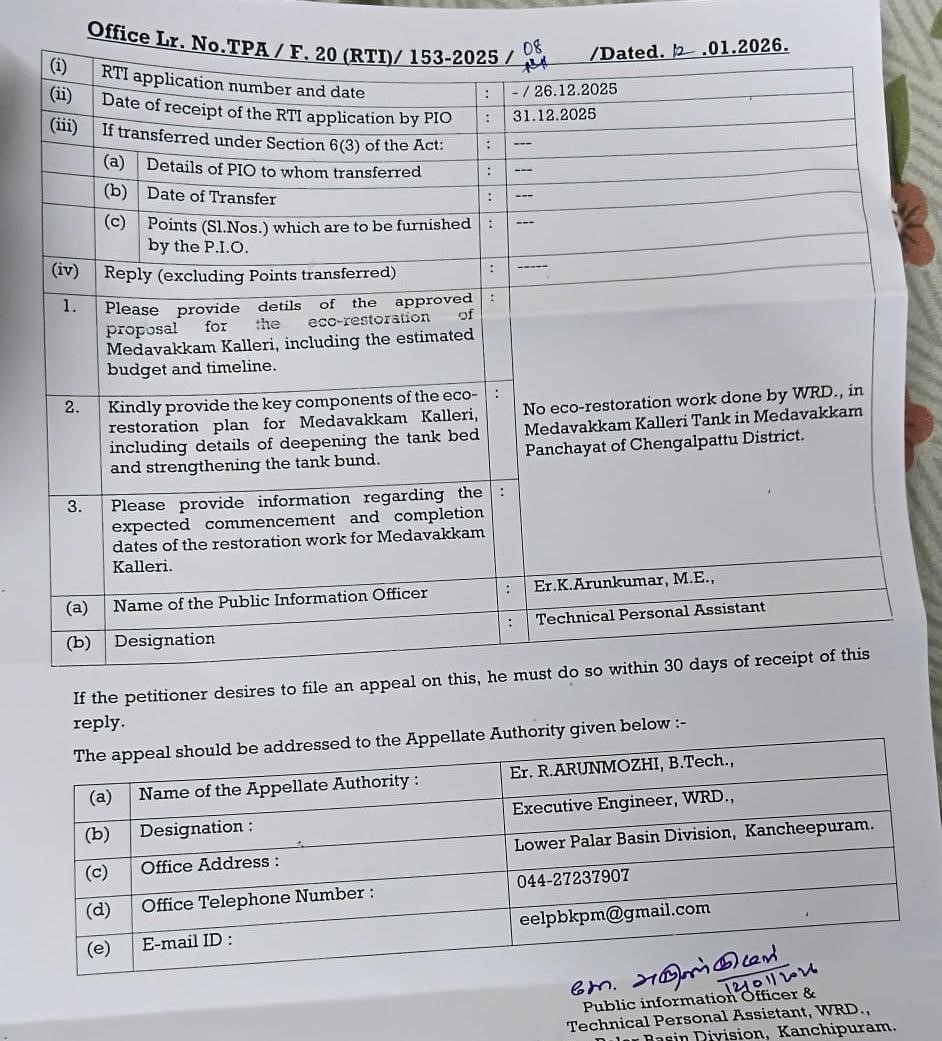
The above case reflects a larger governance challenge
The above case reflects a larger governance challenge when it comes to climate response i.e. while citizen mobilisation creates short visibility and commitments, converting these into sustained institutional action continues to remain a challenge.
Resident Welfare Associations emerge as “Zero Responders”
Beyond citizen campaigns and advocacy efforts, the Medavakkam experience also sheds light on the demographics and actors driving climate resilience and civic action at the local level. According to Arjun, a significant proportion of those actively involved in such initiatives in Medavakkam belonged to the 45-plus age group, including senior citizens and residents associated with Resident Welfare Associations (RWAs). Women’s participation, he observed, was notably stronger than youth participation.
“Youth participation is comparatively less,” he reflected. “For me, getting involved happened almost accidentally after the floods.”
This observation provides an interesting insight into climate participation and civic engagement in Chennai. While the city’s flood responses often highlight youth volunteering during moments of immediate crisis, long-term engagement in ecological restoration, lake governance, and civic accountability appears to rely heavily on older residents and community networks.
The case of Medavakkam also highlights the growing role of RWAs as local governance actors during climate emergencies. In the absence of immediate state response, RWAs frequently serve as “Zero Responders,” facilitating information sharing, coordinating local action, escalating grievances, and mobilising residents around common concerns. Similar patterns can be observed in other flood-prone localities in Chennai, including Velachery.
The need for capacity building measures in citizen-led climate action
Later in the conversation, arjun also reflected critically on some of the restoration efforts themselves. While residents initially focused on measures such as concrete walking paths around the lake, conversations with environmental experts later made them reconsider the long-term ecological implications of excessive concretisation.
“If we had better technical guidance from the beginning, we may have made different choices,” he added.
He suggested that citizen groups and youth volunteers engaged in lake restoration would benefit greatly from structured technical capacity-building initiatives on environmentally sustainable restoration methods. The comment highlights an important dimension of citizen-led climate action i.e. long-term resilience requires accessible technical knowledge, institutional support, and environmentally informed planning frameworks.
The Challenge of long-term planning
According to Arjun, one of the repeated patterns visible in Chennai’s flood responses is that efforts often gain momentum immediately after disasters but lose the sense of urgency in non-crisis periods. While investments in stormwater drains, cut-and-cover drains, lake desilting, and bund strengthening have helped reduce flood risks in several localities, residents argue that deeper structural issues remain insufficiently addressed.
In Medavakkam, concerns continue regarding the health of interconnected lakes, sewage inflows, missing surplus channels, and inadequate outlet systems – issues that require long-term ecological planning. The challenge, according to Arjun, is not the absence of initiatives but the absence of a sustained, preventive approach to urban water management.
“Preventive care is what is missing,” he observed.
Conclusion: From flood-affected residents to ‘Zero responders’
The 2023 floods turned the Medavakkam Periya Eri from being a familiar backdrop into an ecological concern for many residents. In the process, it also made several citizens active participants in environmental governance. Through RTIs, citizen audits, postcard campaigns, media engagement, and restoration efforts, residents of Medavakkam have tried to push climate response conversations from being limited to emergency relief toward long-term planning. Here, the case also shows the limits of such citizen-led responses in the lack of consistent institutional support. Without long-term planning, technical guidance, and stronger channels between communities and governance systems, climate response risks being caught up between cycles of disaster and reaction. At the heart of these efforts sits a broader lesson for Chennai’s climate future i.e. communities are increasingly becoming “Zero Responders,” ecological stakeholders, and local climate actors trying to build resilience from grass roots level. As Chennai continues to face the risk of flooding, the above case in point shows that resilience must be incorporated within the day-to-day governance of lakes, water systems, and urban planning long before the next disaster sets foot.
Dayanand Krishnan, “Lake breach in Medavakkam: Citizen flood audit unearths a host of problems,” Citizen Matters, 16 January 2024
“Residents of Medavakkam raising funds to restore Vadakkupattu lake,” The Hindu, 21 September 2024
Padmaja J, “Residents flood chief secretary with postcards to save lakes in Chennai,” The Times of India, 05 May 2024