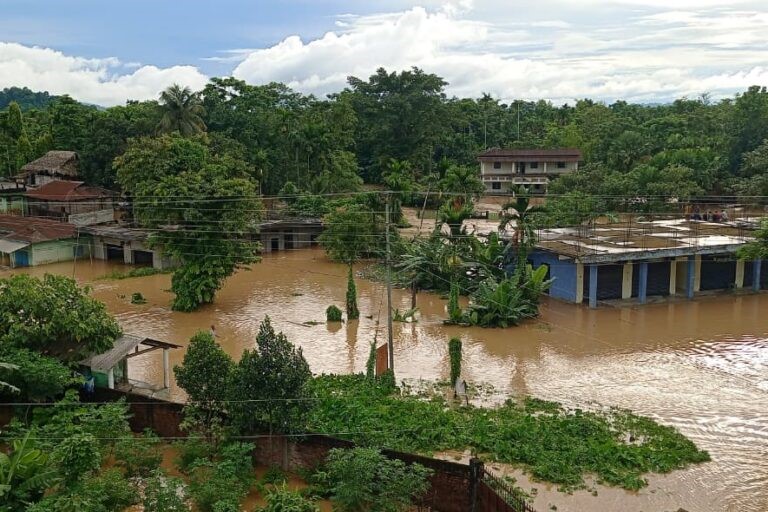
On 20 July, The Assam Tribunal and other major sources reported severe flooding began across Assam after days of intense rainfall in the state. These floods developed to be one of the state’s worst disasters in the recent years. The death toll has now reached 85, while more than 7 lakh people have been displaced by the deluge. As reported by The Indian Express, over 2.12 lakh people remained affected and 13,000 families are still living without electricity.
What triggered the crisis, and how did it unfold?
The 2026 Assam floods broke from the state's usual script. Normally it is the Brahmaputra itself overflowing that drives the disaster; this year, the trigger was excessive upstream rainfall in Nagaland and Arunachal Pradesh, which caused catchment saturation and heavy surface runoff, with south-bank tributaries like the Dikhow, Disang, Janji and Dhansiri rising rapidly past danger marks. Water overtopped embankments before the Brahmaputra itself had even reached peak discharge. Notably, the flooding hit despite Assam receiving significantly less rainfall than normal this season, a paradox explained by the fact that flood risk in a
basin as vast as the Brahmaputra's, fed by catchments across Arunachal Pradesh, Nagaland, Bhutan and the Tibetan plateau, depends on the timing and location of rain far more than the seasonal total. From late July, districts including Golaghat, Sivasagar, Biswanath, Charaideo, Kamrup Metropolitan, Jorhat, Dhemaji and Nagaon were engulfed, with entire villages like Sivasagar's Hiloni Nepali Khuti which is home to roughly 200 Gorkha families were washed away within about an hour. By July 31, the death toll stood at 80, with the affected population assessed at 2,12,441 people across 437 villages in 21 revenue circles in eight districts, and around 17,198 hectares of cropland submerged.
Why Assam floods almost every year despite decades of flood control?
Assam's flood vulnerability is structural, not incidental. Embankments have been India's primary flood-mitigation tool in the state since the 1954 National Policy on Floods, and Assam has since built over 4,900 km of embankments which is the country's densest such network relative to state size. But many structures have exceeded their designed lifespan after decades of deferred maintenance, and riverbank erosion continues to eat away thousands of hectares every year, a slower but arguably more permanent crisis than the floods themselves. This year exposed a further weakness: the state's structurally high-risk zones have traditionally clustered along the Brahmaputra and named tributaries such as the Dikhow, Disang, Dhansiri, Buridehing, Beki and Kushiyara, yet 2026's worst-hit districts, Sivasagar and Charaideo, lie outside Assam's traditional flood belt, meaning flood planning built on historical maps alone is no longer sufficient.
Did authorities have enough warning, and could coordination have softened the blow?
There was advance signalling but not full-proof anticipation. Days before the worst inundation, Chief Minister Himanta Biswa Sarma had already flagged that Assam's flood situation was turning critical following heavy rain in neighbouring Arunachal Pradesh, that the Brahmaputra and its tributaries were above danger level, and that the IMD had warned of two to three more days of heavy rain, prompting the state to keep NDRF and Army teams on standby. Even so, opposition parties have argued the government's response fell short: the Assam Pradesh Congress Committee accused Chief Minister Sarma of failing on flood management, relief distribution and rehabilitation, and demanded his resignation, while Congress leader Rahul Gandhi separately called for a more robust flood response system focused on prevention rather than reaction. Analysts point to a specific coordination gap: since the crisis originated in rainfall over Arunachal Pradesh and Nagaland rather than within Assam, better integration of upstream rainfall data from neighbouring states could help authorities issue earlier warnings and carry out timelier evacuations, a lesson this year's tributary-driven flooding underscores sharply.
How effective was the rescue, relief and rehabilitation response?
The immediate emergency response was substantial in scale. Indian Army troops of the Spear Corps worked alongside NDRF, SDRF and local agencies, conducting rescue and relief operations, providing medical aid, restoring connectivity and reaching remote stranded families, including through logistic drones, while roughly 1,718 relief centres were operational statewide and tens of thousands of displaced people sheltered across dozens of relief camps and distribution centres. On the financial side, the Centre moved relatively fast: Union Home Minister Amit Shah approved an advance release of INR 2,117.85 crore from the central share of the State Disaster Response Fund for seven flood-affected states, of which Assam received INR 379.35 crore, alongside Inter-Ministerial Central Teams deputed to assess damage, with two such visits already conducted in Assam. Yet the human toll of slow recovery remains visible: by late July, many residents whose homes were damaged or filled with mud and silt were still unable to return even after floodwaters receded, and an inter-ministerial team's damage assessment, road repairs and a comprehensive recovery package for lost homes and livestock were still being worked out even as political leaders pushed for a larger central relief package. That gap between reasonably fast emergency rescue and a much slower rehabilitation pipeline is the recurring pattern critics say Assam needs to break.
References
“Monsoon paradox: Why Assam flooded despite a 29% rainfall deficit,” EastMojo, 30 July 2026.
“Outlook Explains | Why Assam Floods Every Year Despite Decades of Flood-Control Projects,” Outlook India, 28 July 2026.
“Assam floods: Rahul seeks robust flood response system with focus on prevention,” Assam Tribune, 27 July 2026.
“Assam floods 2026: Death toll hits 80, over 2.12 lakh people affected in eight districts,” The Statesman, 31 July 2026.
“Home Minister Amit Shah approves advance release of Rs 2,117.85 crore to flood-affected States under SDRF,” ANI, 01 August 2026.
“Centre Releases ₹379.35 Crore SDRF To Assam As Part Of ₹2,117.85-Crore Flood Relief Package,” Free Press Journal, 01 August 2026.
“'Govt Failed to Handle Flood Crisis': Assam Congress Targets Himanta Biswa Sarma,” Pratidin Time, 02 August 2026.
About the Author:
Priyanka Makhijani is a post-graduate student at the Department of Public Policy, School of Social Science, Ramaiah University, Bengaluru.