← Back to Stories
The Heroes of Bhutan

The Heroes of Bhutan

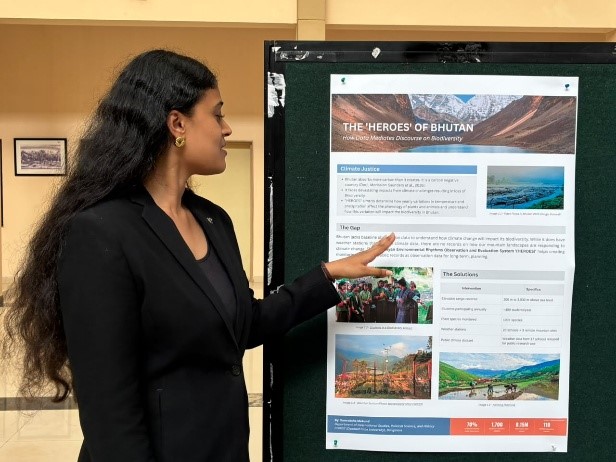
This study finds its premise in the concept of climate justice, that as described by the UN, is an ethical principle that seeks to acknowledge and address the disproportionate implications of climate change on vulnerable communities. Despite being one of the world’s only three carbon negative countries, Bhutan faces disproportionate, often existential impacts of climate change that include, but are not limited to the intersectionality of environmental, economic and cultural domains, particularly considering the country’s reliance on climate-sensitive sectors like agriculture, hydropower, and tourism. This stress is further amplified by the contrast in climatic conditions of Northern Indian planes with higher precipitation and Tibet’s dry, continental highlands, making the Himalayas a fragile, eco-sensitive zone for species in the landscape (Penjor et.al, 2021; Katel et al., 2024).

In times like now, where collective rights are recognized as the third generation of human rights, it becomes increasingly imperative to identify the impacts of climate change to design adaptation strategies. However, the lack of access to baseline bioclimatic data at an appropriate spatial and temporal scale would impede possibilities of observation, prediction, and consequent action. This is where the HEROES – the ‘Himalayan Environmental Rhythms Observation and Evaluation System’ intervenes.

Here, climate change is identified by longitudinally monitoring the life cycles of plants given that phenology, otherwise known as the ‘nature calendar’, is one of its strongest biological indicators (Liang, 2019). Implemented and managed by the Ugyen Wangchuck Institute for Conservation and Environmental Research (UWICER) since 2015, HEROES operates as a citizen science initiative aimed at not only monitoring climate variability and its impact on the terrestrial ecosystem of Bhutan, but also engaging and training students as the next generation of scientists and researchers in the process by integrating a 20 school network that act as weather and observation stations, with an elevation range of between 200m to 3,030m. In addition, students also manage the automatic weather station that logs data every 10 minutes. (HEROES, n.d).

The scale of their operations dated 21/08/26 on their webpage includes 2.8 observations across 110 plant species and the creation of a yearly climate and phenology data where data from 17 schools is made public whilst training over 400 students annually (HEROES, n.d). In addition to their open-source datasets that can be used by researchers, students, and other interested individuals, they organize workshops, seminars, and lectures as part of their initiatives. This convergent, citizen-centric and scientific approach presents an interesting challenge to traditionally top-down technocratic approaches to climate solutions, integrating the ideas of strategic urbanism as described by Chu et al., (2017).

During challenging situations such as these, it becomes integral for people to acknowledge and channelize their agency both as individuals, and as a collective in claiming their rights. Initiatives like these not only promote national interest in scaling capabilities but also engage citizens in ways that make them aware of their responsibilities, paving way for further consequential interventions.

Such initiatives must inspire further action-oriented approaches, specially in countries like India, where biodiversity becomes significant to discourse on the rights of tribal and other aboriginal communities that are grossly underrepresented in governance and developmental platforms. Organizations like the Indian Institute of Bio-Social Research and Development conduct action research linking traditional tribal wisdom on forest blooms, fruiting, and seasonal changes with the Biological Diversity Act to track ecological shifts (IBRAD, n,d).

In this regard, there has been mushrooming of citizen science initiatives in India as well. SeasonWatch, for example, was a project that began in Kerala (2010) and has now branched out with school and individual level program partnerships. These are two that stood out to me – (a) The State Council for Scientific Technology and Environment, Meghalaya, aims to popularize science in the state among the youth. SCSTE introduces several activity-based science learning activities, including SeasonWatch, in the school eco-clubs, through a wide network of interns and volunteers and (b) the Andaman and Nicobar Environment Team that observes 5 species of culturally important plants every week and shares their experiences with children (SeasonWatch, n.d).

While there surely has been progress, the question of what is observed and what is ignored is key in asymmetric societies like India. The observable is what creates a concept of what is actionable, making data central to the very acknowledgement of a problem. The stories of initiatives like HEROES, IBRAD, and SeasonWatch all ask the same questions – whose knowledge is knowledge, and whose problems are problems?

About the author
Samraksha Mukund is a student of the Department of International Studies, Political Science, and History at CHRIST (Deemed to be University), Bangalore.
All Stories
Nepal’s Thame After the 2024 Glacial Flood
26 October 2026 I Grass Roots Chronicle #36
Nepal’s Thame After the 2024 Glacial Flood
Read more →
Maldives Resilient Reefs
26 October 2026 I Grass Roots Chronicle #35
Maldives Resilient Reefs
Read more →
Women Driving Climate Resilience in Bangladesh
26 October 2026 I Grass Roots Chronicle #34
Women Driving Climate Resilience in Bangladesh
Read more →
The Pearl Protectors of Sri Lanka
26 October 2026 I Grass Roots Chronicle #33
The Pearl Protectors of Sri Lanka
Read more →
Nepal’s H.E.L.P. Initiative
26 October 2026 I Grass Roots Chronicle #32
Nepal’s H.E.L.P. Initiative
Read more →
Climate Guardians
26 October 2026 I Grass Roots Chronicle #31
Climate Guardians
Read more →
Restoring the Dry Zone
26 October 2026 I Grass Roots Chronicle #30
Restoring the Dry Zone
Read more →
From Climate Vulnerability to Self-Reliance
26 October 2026 I Grass Roots Chronicle #29
From Climate Vulnerability to Self-Reliance
Read more →
The Heroes of Bhutan
26 October 2026 I Grass Roots Chronicle #28
The Heroes of Bhutan
You are here
Water Conservation, Climate-Resilient Agriculture and Sustainable Livelihoods
26 October 2026 I Grass Roots Chronicle #27
Water Conservation, Climate-Resilient Agriculture and Sustainable Livelihoods
Read more →
Learning Afloat
26 October 2026 I Grass Roots Chronicle #26
Learning Afloat
Read more →
Women, Resilience and the Climate Challenge in Bangladesh
26 October 2026 I Grass Roots Chronicle #25
Women, Resilience and the Climate Challenge in Bangladesh
Read more →
Strengthening Livelihood Resilience among Coastal Women
Oct 15, 2026
Strengthening Livelihood Resilience among Coastal Women
Read more →
The 2026 Assam floods
Aug 26, 2026
The 2026 Assam floods
Read more →
The Hands Restoring Bengaluru’s Lakes
Aug 26, 2026
The Hands Restoring Bengaluru’s Lakes
Read more →
The Ice Stupa artificial glaciers of Phyang village
Aug 26, 2026
The Ice Stupa artificial glaciers of Phyang village
Read more →
Where the Water Returns
Aug 26, 2026
Where the Water Returns
Read more →
Water Warriors of the Himalayas
Aug 26, 2026
Water Warriors of the Himalayas
Read more →
Empowering Communities for a Zero-Waste Tomorrow
30 June 2026 I Grass Roots Chronicle #24
Empowering Communities for a Zero-Waste Tomorrow
Read more →
From Vulnerability to Resilience: A Climate Adaptation Journey
30 June 2026 I Grass Roots Chronicle #23
From Vulnerability to Resilience: A Climate Adaptation Journey
Read more →
Hulimavu's Blue Revolution
30 June 2026 I Grass Roots Chronicle #22
Hulimavu's Blue Revolution
Read more →
Climate Justice from the Ground Up
30 June 2026 I Grass Roots Chronicle #21
Climate Justice from the Ground Up
Read more →
Every Disaster Predicted, Every Community Ready
30 June 2026 I Grass Roots Chronicle #20
Every Disaster Predicted, Every Community Ready
Read more →
The Women Who Salt the Earth and Harness the Sun
30 June 2026 I Grass Roots Chronicle #19
The Women Who Salt the Earth and Harness the Sun
Read more →
Guardians in Green
30 June 2026 I Grass Roots Chronicle #18
Guardians in Green
Read more →
Voices for a Changing Climate
30 June 2026 I Grass Roots Chronicle #17
Voices for a Changing Climate
Read more →
Friends of Lakes
30 June 2026 I Grass Roots Chronicle #16
Friends of Lakes
Read more →
The Climate Classroom
30 June 2026 I Grass Roots Chronicle #15
The Climate Classroom
Read more →
The Seeds of Change
30 June 2026 I Grass Roots Chronicle #14
The Seeds of Change
Read more →
The Students Who Heal the Soil and Study the Land
30 June 2026 I Grass Roots Chronicle #13
The Students Who Heal the Soil and Study the Land
Read more →
Roots, Rain & Renewal
30 June 2026 I Grass Roots Chronicle #12
Roots, Rain & Renewal
Read more →
The Forests That Refused to Fall
30 June 2026 I Grass Roots Chronicle #11
The Forests That Refused to Fall
Read more →
The Forest She Built
30 June 2026 I Grass Roots Chronicle #10
The Forest She Built
Read more →
Lakeika: Breathing Life Back into Puttenahalli
30 June 2026 I Grass Roots Chronicle #09
Lakeika: Breathing Life Back into Puttenahalli
Read more →
Banking on Plates for a Clean World
30 June 2026 I Grass Roots Chronicle #08
Banking on Plates for a Clean World
Read more →
Chintan Environmental Research and Action Group
30 June 2026 I Grass Roots Chronicle #07
Chintan Environmental Research and Action Group
Read more →
The Lakeika of India
27 May 2026 I Grass Roots Chronicle #06
The Lakeika of India
Read more →
The Lake Man of India
27 May 2026 I Grass Roots Chronicle #05
The Lake Man of India
Read more →
Every forest needs a Bengalata
27 May 2026 I Grass Roots Chronicle #04
Every forest needs a Bengalata
Read more →
The Spring Keepers of Uttarakhand
27 May 2026 I Grass Roots Chronicle #03
The Spring Keepers of Uttarakhand
Read more →
The Voice of Garhwal at 90.8 FM
27 May 2026 I Grass Roots Chronicle #02
The Voice of Garhwal at 90.8 FM
Read more →
The HEAL Movement
27 May 2026 I Grass Roots Chronicle #01
The HEAL Movement
Read more →
India: Engineer Gurunandan Rao's science-led effort to revive Bengaluru's Lalbagh Lake
Feb 26, 2026
India: Engineer Gurunandan Rao's science-led effort to revive Bengaluru's Lalbagh Lake
Read more →
India: Supriya Sahu highlights Tamil Nadu's expansion of reserved forests to strengthen climate resilience
Feb 20, 2026
India: Supriya Sahu highlights Tamil Nadu's expansion of reserved forests to strengthen climate resilience
Read more →
Jadav Payeng, often called the "Forest Man of India," spent roughly four decades planting trees on a barren sandbar along the Brahmaputra River in Assam
Feb 15, 2026
Jadav Payeng, often called the "Forest Man of India," spent roughly four decades planting trees on a barren sandbar along the Brahmaputra River in Assam
Read more →
They Called Her "Just A Maami In A Saree". She Proved She Was A Force Of Nature
Feb 10, 2026
They Called Her "Just A Maami In A Saree". She Proved She Was A Force Of Nature
Read more →
How a Kolkata Neighborhood Saved its 70-Year-Old Tamarind Tree through Cultural Resistance
Jan 15, 2026
How a Kolkata Neighborhood Saved its 70-Year-Old Tamarind Tree through Cultural Resistance
Read more →
How Tree Lovers Rescued a Kolkata Neighbourhood
Dec 15, 2025
How Tree Lovers Rescued a Kolkata Neighbourhood
Read more →
The Indian Public Servant Helping Disadvantaged Communities Adapt To Rising Heat
Dec 10, 2025
The Indian Public Servant Helping Disadvantaged Communities Adapt To Rising Heat
Read more →
Meet the Lake Man Reviving 1000+ Drought-Hit South Indian Villages
Oct 20, 2025
Meet the Lake Man Reviving 1000+ Drought-Hit South Indian Villages
Read more →
37 Villages Resolve To Protect Ntangki National Park At Athibung Consultation
Oct 17, 2025
37 Villages Resolve To Protect Ntangki National Park At Athibung Consultation
Read more →
How Women Farmers in the Sundarban Are Reviving Indigenous Rice Varieties
May 15, 2025
How Women Farmers in the Sundarban Are Reviving Indigenous Rice Varieties
Read more →