← Back to Stories
Nepal’s Thame After the 2024 Glacial Flood

Nepal’s Thame After the 2024 Glacial Flood

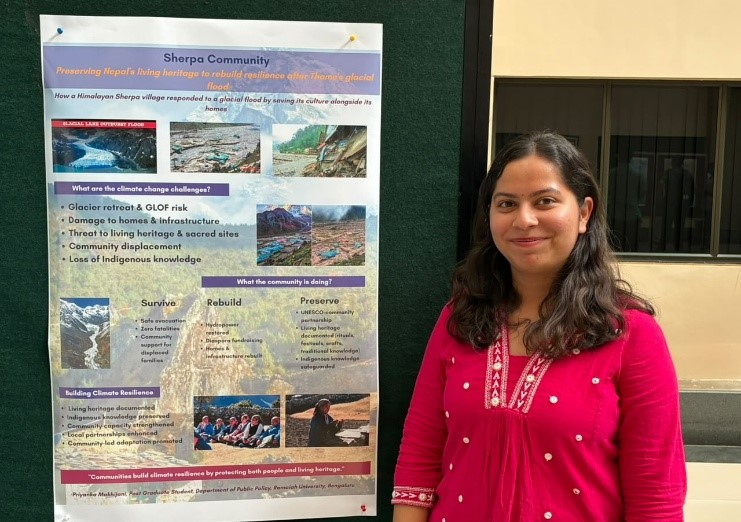
On 16 August 2024, a glacial lake outburst flood (GLOF) tore through Thame, a 3,800-metre Sherpa village in Nepal's Everest region. The disaster was triggered by a cascading failure of two glacial lakes above the settlement, set off by rising temperatures and heavy rainfall, and the floodwaters reached the village within roughly half an hour of the initial breach. Homes, a school, and a health post were destroyed. One hundred and thirty-five people were displaced, though remarkably no lives were lost, largely because most residents were away at the weekly Namche market when the flood struck. Nepal's own hydrology department later linked the event directly to warming, noting that average temperatures in the area had risen sharply in the days before the flood. What happened afterward in Thame is a useful case study in how civil society, acting largely on its own initiative, can respond to climate disaster not only by rebuilding what was lost, but by protecting the knowledge that makes future survival possible.

Recovery began quickly on the physical front. Because the flood struck during daylight, most residents reached higher ground in time, and within weeks the forty-six displaced schoolchildren had resumed classes nearby. The Khumbu Electricity Company, a locally run utility, restored the village's hydropower supply in just eighteen days, and Nepal's rural municipality allocated funds for rebuilding homes, roads, and bridges. This kind of response, fast, self-organised, and largely independent of outside contractors, is a familiar pattern in civil society's response to climate disasters. What is less familiar, and more instructive, is what Thame did next.

The flood swept away the village's sacred Mani stones, carved scripture stones central to Sherpa ritual life, and for ten months afterward the community performed no rituals at all. Rather than treating this loss as separate from disaster recovery, the community treated it as part of the same problem: the knowledge embedded in its culture, about the land, the seasons, and how to live safely in this environment, was as vulnerable to the flood as any building. If that knowledge was not captured, the next generation would inherit a landscape without the accumulated understanding that had helped previous generations manage it.

In response, Thame partnered with UNESCO to document and formalise that knowledge before more of it was lost. Working within the framework of the 2003 Convention for the Safeguarding of the Intangible Cultural Heritage and the Local and Indigenous Knowledge Systems programme, more than thirty local stakeholders, including Indigenous youth, women's groups, and monastery leaders, took part in identifying and validating an inventory of eight living-heritage elements: traditional food knowledge, craftsmanship, cosmology and nature knowledge, and festival and ritual practices. Several of these, particularly the cosmology and nature knowledge and traditional farming practices, are not merely symbolic; they encode generations of observation about seasonal risk, land use, and environmental change specific to this valley.

Capturing them was not an act of nostalgia but an act of knowledge management.

This is what makes the initiative a genuine civil society climate response rather than a cultural side project. The resulting inventory is being considered for Nepal's National Inventory of Intangible Cultural Heritage, and, more significantly, its findings are expected to feed directly into the revision of the Sagarmatha National Park Management Plan. In practice, this means locally held ecological knowledge, gathered and validated by the community itself, is set to shape official disaster planning for the wider region, rather than remaining folklore disconnected from policy. The entire process followed the principle of Free, Prior, and Informed Consent, meaning the community, not UNESCO, decided which knowledge was recorded and how it was represented, ensuring that the information feeding into climate planning stayed accountable to the people who hold it.

Thame's experience suggests a specific model for civil society's role in climate adaptation: communities do not only need help rebuilding physical infrastructure after a disaster; they need support capturing and formalising the knowledge that disasters put at risk of disappearing, so it can inform how future risk is managed. This reframes intangible cultural heritage from a matter of sentiment into a matter of practical resilience: the people who have farmed, foraged, and navigated a particular valley for centuries hold information about that landscape that no outside agency can independently generate, and losing it quietly, alongside the physical damage of a disaster, would be a second, less visible loss. The risk in the Himalaya has not passed. Several glacial lakes above Thame remain classified as high or moderate risk, and similar floods have since struck other Nepali villages, including Tilgau in 2025. Engineering measures such as riverbank stabilisation and early-warning stations will help, but Thame's case argues that local knowledge, properly documented and given real standing in official planning, is itself a form of climate infrastructure, and one that only the community holding it can supply.

About the author
Priyanka Makhijani Postgraduate student, Department of Public Policy, Ramaiah University of Applied science.
All Stories
Nepal’s Thame After the 2024 Glacial Flood
26 October 2026 I Grass Roots Chronicle #36
Nepal’s Thame After the 2024 Glacial Flood
You are here
Maldives Resilient Reefs
26 October 2026 I Grass Roots Chronicle #35
Maldives Resilient Reefs
Read more →
Women Driving Climate Resilience in Bangladesh
26 October 2026 I Grass Roots Chronicle #34
Women Driving Climate Resilience in Bangladesh
Read more →
The Pearl Protectors of Sri Lanka
26 October 2026 I Grass Roots Chronicle #33
The Pearl Protectors of Sri Lanka
Read more →
Nepal’s H.E.L.P. Initiative
26 October 2026 I Grass Roots Chronicle #32
Nepal’s H.E.L.P. Initiative
Read more →
Climate Guardians
26 October 2026 I Grass Roots Chronicle #31
Climate Guardians
Read more →
Restoring the Dry Zone
26 October 2026 I Grass Roots Chronicle #30
Restoring the Dry Zone
Read more →
From Climate Vulnerability to Self-Reliance
26 October 2026 I Grass Roots Chronicle #29
From Climate Vulnerability to Self-Reliance
Read more →
The Heroes of Bhutan
26 October 2026 I Grass Roots Chronicle #28
The Heroes of Bhutan
Read more →
Water Conservation, Climate-Resilient Agriculture and Sustainable Livelihoods
26 October 2026 I Grass Roots Chronicle #27
Water Conservation, Climate-Resilient Agriculture and Sustainable Livelihoods
Read more →
Learning Afloat
26 October 2026 I Grass Roots Chronicle #26
Learning Afloat
Read more →
Women, Resilience and the Climate Challenge in Bangladesh
26 October 2026 I Grass Roots Chronicle #25
Women, Resilience and the Climate Challenge in Bangladesh
Read more →
Strengthening Livelihood Resilience among Coastal Women
Oct 15, 2026
Strengthening Livelihood Resilience among Coastal Women
Read more →
The 2026 Assam floods
Aug 26, 2026
The 2026 Assam floods
Read more →
The Hands Restoring Bengaluru’s Lakes
Aug 26, 2026
The Hands Restoring Bengaluru’s Lakes
Read more →
The Ice Stupa artificial glaciers of Phyang village
Aug 26, 2026
The Ice Stupa artificial glaciers of Phyang village
Read more →
Where the Water Returns
Aug 26, 2026
Where the Water Returns
Read more →
Water Warriors of the Himalayas
Aug 26, 2026
Water Warriors of the Himalayas
Read more →
Empowering Communities for a Zero-Waste Tomorrow
30 June 2026 I Grass Roots Chronicle #24
Empowering Communities for a Zero-Waste Tomorrow
Read more →
From Vulnerability to Resilience: A Climate Adaptation Journey
30 June 2026 I Grass Roots Chronicle #23
From Vulnerability to Resilience: A Climate Adaptation Journey
Read more →
Hulimavu's Blue Revolution
30 June 2026 I Grass Roots Chronicle #22
Hulimavu's Blue Revolution
Read more →
Climate Justice from the Ground Up
30 June 2026 I Grass Roots Chronicle #21
Climate Justice from the Ground Up
Read more →
Every Disaster Predicted, Every Community Ready
30 June 2026 I Grass Roots Chronicle #20
Every Disaster Predicted, Every Community Ready
Read more →
The Women Who Salt the Earth and Harness the Sun
30 June 2026 I Grass Roots Chronicle #19
The Women Who Salt the Earth and Harness the Sun
Read more →
Guardians in Green
30 June 2026 I Grass Roots Chronicle #18
Guardians in Green
Read more →
Voices for a Changing Climate
30 June 2026 I Grass Roots Chronicle #17
Voices for a Changing Climate
Read more →
Friends of Lakes
30 June 2026 I Grass Roots Chronicle #16
Friends of Lakes
Read more →
The Climate Classroom
30 June 2026 I Grass Roots Chronicle #15
The Climate Classroom
Read more →
The Seeds of Change
30 June 2026 I Grass Roots Chronicle #14
The Seeds of Change
Read more →
The Students Who Heal the Soil and Study the Land
30 June 2026 I Grass Roots Chronicle #13
The Students Who Heal the Soil and Study the Land
Read more →
Roots, Rain & Renewal
30 June 2026 I Grass Roots Chronicle #12
Roots, Rain & Renewal
Read more →
The Forests That Refused to Fall
30 June 2026 I Grass Roots Chronicle #11
The Forests That Refused to Fall
Read more →
The Forest She Built
30 June 2026 I Grass Roots Chronicle #10
The Forest She Built
Read more →
Lakeika: Breathing Life Back into Puttenahalli
30 June 2026 I Grass Roots Chronicle #09
Lakeika: Breathing Life Back into Puttenahalli
Read more →
Banking on Plates for a Clean World
30 June 2026 I Grass Roots Chronicle #08
Banking on Plates for a Clean World
Read more →
Chintan Environmental Research and Action Group
30 June 2026 I Grass Roots Chronicle #07
Chintan Environmental Research and Action Group
Read more →
The Lakeika of India
27 May 2026 I Grass Roots Chronicle #06
The Lakeika of India
Read more →
The Lake Man of India
27 May 2026 I Grass Roots Chronicle #05
The Lake Man of India
Read more →
Every forest needs a Bengalata
27 May 2026 I Grass Roots Chronicle #04
Every forest needs a Bengalata
Read more →
The Spring Keepers of Uttarakhand
27 May 2026 I Grass Roots Chronicle #03
The Spring Keepers of Uttarakhand
Read more →
The Voice of Garhwal at 90.8 FM
27 May 2026 I Grass Roots Chronicle #02
The Voice of Garhwal at 90.8 FM
Read more →
The HEAL Movement
27 May 2026 I Grass Roots Chronicle #01
The HEAL Movement
Read more →
India: Engineer Gurunandan Rao's science-led effort to revive Bengaluru's Lalbagh Lake
Feb 26, 2026
India: Engineer Gurunandan Rao's science-led effort to revive Bengaluru's Lalbagh Lake
Read more →
India: Supriya Sahu highlights Tamil Nadu's expansion of reserved forests to strengthen climate resilience
Feb 20, 2026
India: Supriya Sahu highlights Tamil Nadu's expansion of reserved forests to strengthen climate resilience
Read more →
Jadav Payeng, often called the "Forest Man of India," spent roughly four decades planting trees on a barren sandbar along the Brahmaputra River in Assam
Feb 15, 2026
Jadav Payeng, often called the "Forest Man of India," spent roughly four decades planting trees on a barren sandbar along the Brahmaputra River in Assam
Read more →
They Called Her "Just A Maami In A Saree". She Proved She Was A Force Of Nature
Feb 10, 2026
They Called Her "Just A Maami In A Saree". She Proved She Was A Force Of Nature
Read more →
How a Kolkata Neighborhood Saved its 70-Year-Old Tamarind Tree through Cultural Resistance
Jan 15, 2026
How a Kolkata Neighborhood Saved its 70-Year-Old Tamarind Tree through Cultural Resistance
Read more →
How Tree Lovers Rescued a Kolkata Neighbourhood
Dec 15, 2025
How Tree Lovers Rescued a Kolkata Neighbourhood
Read more →
The Indian Public Servant Helping Disadvantaged Communities Adapt To Rising Heat
Dec 10, 2025
The Indian Public Servant Helping Disadvantaged Communities Adapt To Rising Heat
Read more →
Meet the Lake Man Reviving 1000+ Drought-Hit South Indian Villages
Oct 20, 2025
Meet the Lake Man Reviving 1000+ Drought-Hit South Indian Villages
Read more →
37 Villages Resolve To Protect Ntangki National Park At Athibung Consultation
Oct 17, 2025
37 Villages Resolve To Protect Ntangki National Park At Athibung Consultation
Read more →
How Women Farmers in the Sundarban Are Reviving Indigenous Rice Varieties
May 15, 2025
How Women Farmers in the Sundarban Are Reviving Indigenous Rice Varieties
Read more →